SortBot: Object Rearrangement in Household Environment
Feb – Apr 2026
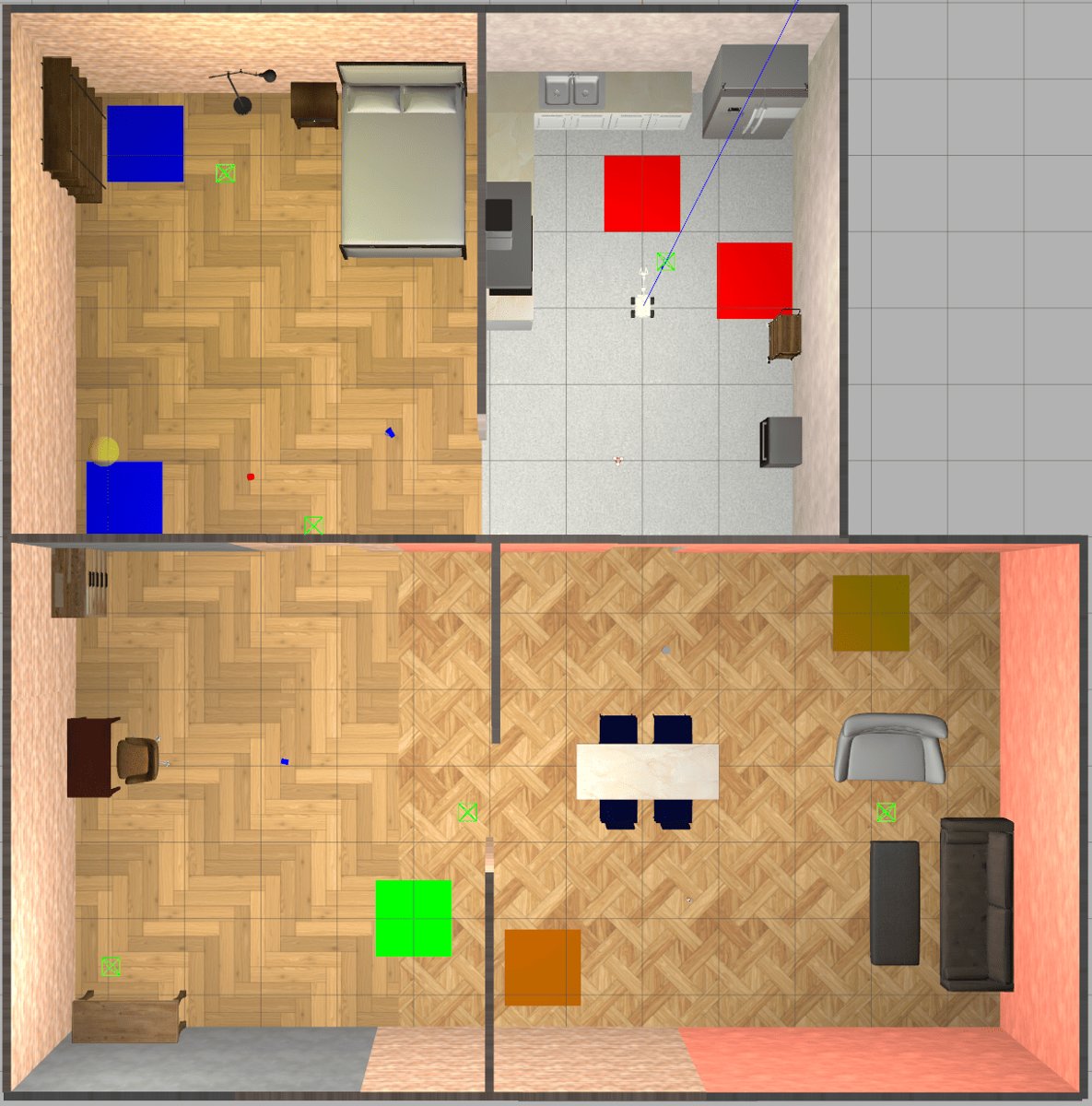
SortBot is a knowledge-based decision-making system for autonomous household item sorting in a partially observable, simulated 4-room home. The robot explores to discover objects, reasons about where each one belongs, and plans how to put everything away.
The system runs as a ROS 2 C++ package with three layers:
- PDDL planning via PlanSys2 (POPF and OPTIC planners), with move costs computed at runtime from waypoint distances.
- Semantic reasoning via TypeDB, whose rules categorise objects and infer drop locations (for example, dirty tableware → dishwasher).
- Navigation via Nav2, with each PDDL action executed by its own ROS 2 lifecycle node.
It tackles three tasks of increasing complexity:
- Room-level sorting in a fixed room order, with inter-room distances guiding the plan.
- Semantic sorting, where an interleaved cross-room exploration and execution strategy drops objects as soon as their targets are known. Compared with exploring everything first, it reduced task completion time by 15%, and it succeeded where the full-exploration baseline failed with the OPTIC planner.
- Clue-driven search for a target object, where TypeDB rules use observed objects as clues to prioritise the room search order, achieving a 43% speedup over a naive room-ordering baseline.